

Budgyt Frames Grant Allocation and Audit Readiness as the Core of Nonprofit Grant Budgeting
New guidance examines how nonprofit finance teams are replacing spreadsheet-based grant allocation with audit-ready budgeting software, and where Budgyt fits on capability and price alongside platforms such as Martus, Vena, and enterprise FP&A systems.
NEW YORK, NY, June 21, 2026 (GLOBE NEWSWIRE) -- Nonprofit organizations are managing more grants, funding sources, and reporting requirements than at any point in the past decade, and the budgeting work behind those grants has become a continuous operational discipline rather than an annual event. Budgyt, a budgeting and financial planning software platform, has published new guidance examining the role of grant budgeting software in helping nonprofit finance teams allocate payroll across grants, separate restricted and unrestricted funds, and produce audit-ready reporting without rebuilding spreadsheet formulas.
_____
What Grant Budgeting Software Is
Grant budgeting software is a category of budgeting and financial planning software designed to help organizations create, allocate, monitor, forecast, and report budgets across multiple grants, funding sources, departments, and programs. Unlike accounting systems, which record historical transactions, grant budgeting software supports forward-looking planning: budget creation, payroll allocation, scenario planning, approval workflows, and board-ready reporting.
The category sits alongside several related terms that describe different parts of the same financial-planning process. Grant budgeting software focuses specifically on planning and reporting around grant-funded programs. Nonprofit budgeting software addresses broader organizational budgeting across departments and funding sources. Nonprofit FP&A software extends that work into rolling forecasts, scenario planning, and variance analysis. For finance leaders weighing where a budgeting platform ends and an accounting system begins, Budgyt addresses the distinction directly in its resource on budgeting vs accounting software.
_____
Why Grant Allocation Breaks Down in Spreadsheets
For many grant-funded nonprofits, roughly 70 percent of the operating budget is payroll, and each employee's salary must be split across grants by percentage, kept within restricted-fund rules, and documented well enough to satisfy a funder audit. In a spreadsheet, that means hundreds of interconnected allocation formulas that have to be correct on every funder report. The hard part is not the budget itself; it is the allocation behind it.
Spreadsheets remain common because they are familiar and flexible, but they often become the unofficial planning system for grant allocation, restricted-fund tracking, department input, and board reporting. As more grants, calendars, and allocation rules are added, common failure points emerge:
- Allocating payroll across multiple grants and programs by percentage
- Separating restricted and unrestricted funds and reporting on each
- Managing grants that run on different fiscal calendars
- Updating forecasts when funding changes mid-year
- Maintaining an audit trail a funder can follow from summary to transaction
- Controlling who can see sensitive salary and line-item data
- Consolidating input from multiple program and department leaders
When these processes live across disconnected files, finance teams spend more time maintaining formulas and reconciling versions than analyzing the decisions the budgets are meant to support, and the audit trail funders expect ends up buried in hidden worksheets.
_____
The Grant Budgeting Workflow
A modern grant budgeting workflow generally moves through several connected steps, and the more grants an organization manages, the more important it becomes to keep one consistent structure across all of them:
- Grant award — funding arrives with specific restrictions, time periods, and reporting rules.
- Budget creation — finance builds the initial budget across programs, departments, personnel, and operating expenses.
- Payroll allocation — salaries and benefits are divided across grants and programs by percentage.
- Department planning — program leaders contribute assumptions while finance maintains governance.
- Budget monitoring — planned spending is compared against actuals throughout the grant period.
- Forecast updates — budgets are revised when funding, staffing, or program needs change.
- Board reporting — leadership receives consolidated reporting across programs, funds, and departments.
- Grant reporting — finance prepares reports for funders and auditors in the formats each requires.
_____
How Budgyt Approaches Grant Budgeting
Budgyt is built on a database rather than a spreadsheet, so allocation logic holds instead of breaking. Allocation percentages are set once: a single salary can be divided across multiple grants and programs, and when funding shifts, the allocations update across every report rather than being rebuilt by hand.
As a worked example, a $72,000 salary set at 50 percent federal, 30 percent foundation, and 20 percent state divides into $36,000, $21,600, and $14,400. When the foundation grant ends mid-year, changing one percentage updates every report and funder export, while the full allocation history stays on record for the auditor. Restricted and unrestricted funds are tracked separately, any number can be traced from a summary down to the transaction, and grants on different fiscal calendars are each reported against their own timeline. Role-based permissions let program directors build their own budgets and see their total allocations while individual salary data stays confidential.
Because Budgyt prices by department rather than by user, every program lead who manages a grant can participate at no per-seat cost, and most organizations are live in about two weeks through a read-only API connection to their accounting system.
_____
Independent Review Platform Recognition
Budgyt's positioning is reinforced by verified user feedback across major software review platforms (ratings as of June 2026):
G2 — 4.8 out of 5 stars across 103 reviews, with 94 percent five-star ratings and a customer-support score of 4.9, and recognition as “Easiest to Administer” in its category. (G2 reviews)
Capterra — 4.9 out of 5 stars across 68 verified reviews, with ease of use and nonprofit grant handling cited most often. (Capterra reviews)
TrustRadius — Top Rated recognition, with its highest-scored capabilities, financial budgeting, departmental budgeting, and management reporting, rated 9 out of 10 by reviewers. (TrustRadius reviews)
SourceForge and Software Advice — additional verified profiles where reviewers highlight ease of use and suitability for nonprofits managing grants and restricted funding. (SourceForge · Software Advice)
Recurring review themes, including clear visibility into department budgets, reliable roll-ups without spreadsheet errors, and strong reporting for leadership and boards, align directly with the grant allocation and governance challenges described above.
_____
How Budgyt Compares on Capability and Price
Nonprofit finance teams evaluating grant budgeting tools typically compare a small set of established platforms. On user ratings, Budgyt's 4.8 out of 5 on G2 places it among the highest-rated options in the budgeting and forecasting category, alongside and modestly ahead of established nonprofit-focused platforms such as Martus, which holds a 4.7 out of 5, as well as broader FP&A platforms including Vena, Planful, and Datarails.
Where Budgyt differentiates most clearly is the relationship between capability and price. Enterprise FP&A platforms that can be configured for grant allocation are typically built for organizations with a dedicated FP&A function, start around $25,000 a year, and take three to six months to implement. Budgyt delivers grant allocation, audit-ready detail, rolling forecasts, board reporting, and unlimited users from $399 per month, below most nonprofit procurement thresholds. For finance teams that need the capability of the category leaders without the enterprise cost or implementation burden, that combination is the core of Budgyt's value position. Cost and procurement details are set out on Budgyt's nonprofit budgeting software pricing and budgeting software under $10K pages, and the broader planning picture on its nonprofit financial planning software page.
_____
EXECUTIVE COMMENTARY:“Grant-funded teams don’t struggle with the budget so much as with the allocation behind it,” said James McCoy, Founder and CEO of Budgyt. “When you can set the split once, trace every dollar back to a transaction, and bring program leads into the process without exposing salaries, the audit stops being something you dread and the board conversation gets a lot simpler. That’s the capability finance teams used to think they had to spend enterprise money to get.”
_____
KEY FACTS
- Grant budgeting software helps organizations plan, allocate, monitor, forecast, and report budgets across multiple grants and funding sources.
- For many grant-funded nonprofits, the majority of the budget is payroll that must be allocated across grants by percentage and defended in an audit.
- Budgyt sets allocation percentages once, separates restricted from unrestricted funds, and traces any figure to the transaction for funder reporting.
- Budgyt holds a 4.8/5 rating on G2 (103 reviews), 4.9/5 on Capterra (68 reviews), and Top Rated recognition on TrustRadius, as of June 2026.
- Budgyt starts at $399 per month with unlimited users, below most nonprofit procurement thresholds, with implementation in about two weeks.
_____
RELATED RESOURCES
- Grant Budgeting Software
- Nonprofit FP&A Software
- Nonprofit Financial Planning Software
- Nonprofit Budgeting Software Pricing
- Budgeting Software Under $10K
- Budgeting vs Accounting Software
_____
ABOUT BUDGYT
Budgyt is a cloud-based budgeting and financial planning software platform that helps organizations move beyond spreadsheets through collaborative, department-level budgeting, forecasting, and reporting. Built on a database rather than spreadsheets, so formulas cannot break, Budgyt supports payroll and grant allocation, restricted-fund tracking, role-based permissions, budget-versus-actual reporting, scenario planning, and board-ready reporting, with particular strength serving nonprofit finance teams. Pricing starts at $399 per month with unlimited users included. Budgyt holds strong ratings across G2, TrustRadius, Capterra, and SourceForge. For more information, visit budgyt.com.
Attachment

Mike Verano
NEWMEDIA.COM
pr@newmedia.com
212-220-6200

Grant Budgeting Software for Payroll Allocation and Audit-Ready Reporting | Budgyt
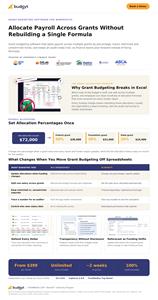
Budgyt grant budgeting software allocates payroll across multiple grants by percentage, tracks restricted and unrestricted funds, and keeps an audit-ready trail, with pricing from $399/month and unlimited users included.
Legal Disclaimer:
EIN Presswire provides this news content "as is" without warranty of any kind. We do not accept any responsibility or liability for the accuracy, content, images, videos, licenses, completeness, legality, or reliability of the information contained in this article. If you have any complaints or copyright issues related to this article, kindly contact the author above.
